
Michal's Eat New Zealand Food Hui Highlights

Updated: Oct 9, 2025
I’ve just spent one and a half days at the Eat New Zealand Food Hui. It was a fantastic couple of days of kōrero and connecting with people who work in and throughout Aotearoa’s entire food system. I came away with a great deal of new learning and wanted to share some of my key highlights and takeaways with you all.
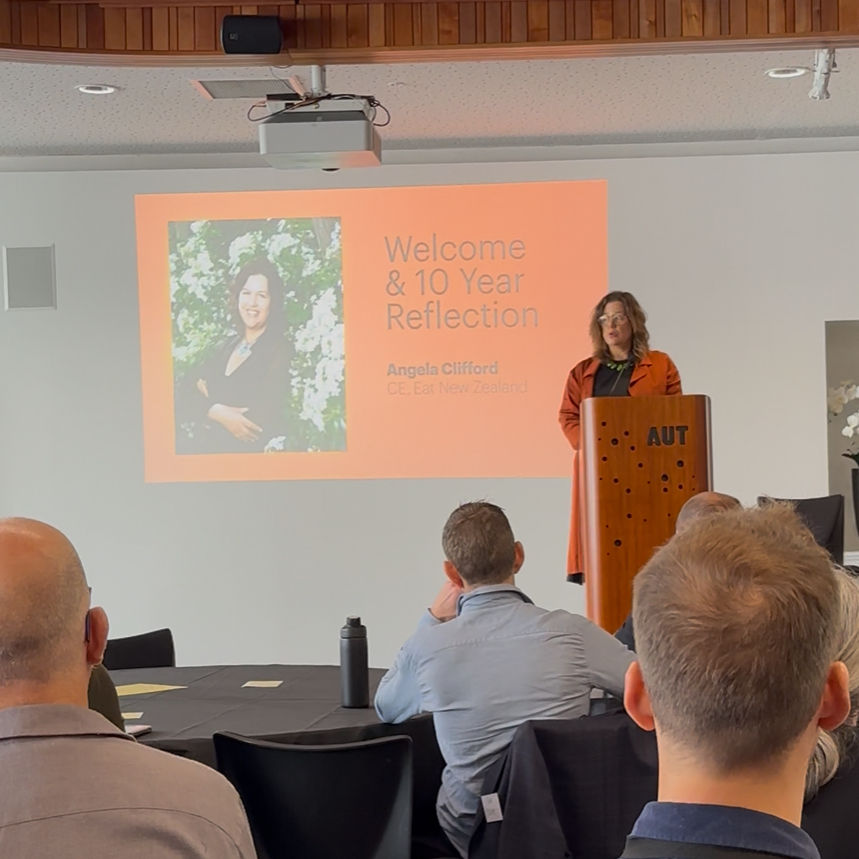
This year, Eat New Zealand celebrates its tenth birthday. A huge achievement for any organisation, let alone a not-for-profit advocating for a fairer food system in Aotearoa. So it was fitting that CEO, Angela Clifford, opened the Hui, sharing some of her key reflections on leading the organisation. In true Angela style, she referenced “you and I” throughout the speech, sharing that this was everyone’s journey and thanking those who have walked it alongside her. Some of her key moments, including the evolution of Feast Matariki; her National Food Strategy petition and campaign; her advocacy for local food - including everyone from the farmer to the eater; and the Eat New Zealand Kaitaki (of which I’m so proud to be one of!).
The Hui then launched Vote for Kai. A campaign in the lead-up to next year’s general election, asking for politicians to put kai front and centre when it comes to policy. This includes everything from growers & producers, to cost & accessibility, food sovereignty & security and of course, waste.
As the cost of living and the cost of food continue to rise, access to good, nutritious kai has become more and more out of reach for a growing number of Kiwis.
The Hui highlighted that a key reason for this is that food is seen as a commodity - something to be traded for money - rather than a human necessity that everyone should have access to.
This point was beautifully articulated by Moko Morris from Kore Hiakai Zero Hunger Collective during the Vote for Kai Panel. Moko defined the difference between food, a commodity and kai, part of a natural system of which humans are included.
I cannot do justice to the beautiful words that Moko used, but she created an image that kai starts below the ground, in the soil that’s filled with crawlies and roots, it continues above to those that walk on the ground, with two legs or four. Out into our oceans, lakes and rivers and those that inhabit those depths. And up into the forests with those who flutter through the trees. It was such a stunning visual as well as a reminder that we, humans, are part of te taiao, despite our constant attempts to put ourselves above it. This really grounded the rest of the Hui for me and are words that I’ll carry long into the future.
Up next was Kai Motuhake where Dr Madeline Schelling shared her research into how we define food insecurity and the cultural bias in the current system. It was notable that almost all of the current questions focus only on money and do not speak to people who grow and gather their own food. I am very excited to see what comes out of this research.
Lunch was put on by Archana Kurup and the Everybody Eats team using rescued ingredients from Fair Food.
The afternoon kicked off with a hearing about the rise of regional kai systems, including work that councils and local food rescue organisations are doing. Before turning to how we take the Hauraki Gulf back to abundance.
Up next was hearing about the challenges that are imposed on local food producers. This panel once again highlighted the inequities in our food system, where small local producers are often hit with the same fees and held to the same standards as large-scale producers. Alex Morrissey stole our hearts speaking about growing local, organic kai while holding the future (her baby) on her hip.
The penultimate panel left us feeling hopeful after a day that had touched on some pretty heavy discussions. This was a handful of Kaitaki sharing their visions for Food on Aotearoa twenty years into the future. The visions included locally grown and connected food systems. Hospitality is just that, hospitable, and everyone has fair, equal and affordable access to kai. And importantly, a vision of a world where food is valued and not wasted.

Day one was wrapped up by Giulio Sturla, restaurateur and founder of Eat New Zealand. Giulio shared his story, coming to Aotearoa after hearing about our abundance of incredible ingredients, which quickly turned to disappointment that he was unable to fish in the harbour. He started making calls to anyone in the industry who would listen, and this was the start of the movement that has become Eat New Zealand. Giulio had my very favourite quote of the day: “That we should be judging a restaurant by what’s in its bin.”
Day Two of the Hui kicked off with the launch of the New Zealand Grain Mark. This aims to identify which grains are grown here in Aotearoa - a game-changer for local growers.
Next up were the day's keynote speakers - Nadia Lim and Carlos Bagrie. They shared some of their own challenges growing grain and other crops on their central Otago station, Royalburn. The thing that stood out to me the most, and well frankly outraged me, was that it is cheaper for the North Island to import grain grown in Australia or even South America than it is to access grain grown in the South Island. This is due to the high cost of road freight used in New Zealand, coupled with the cost of getting over the Cook Strait. The other point that I found heartbreaking was that only about 10% of the beautiful grain they grow is actually consumed by humans; the rest goes towards animal feed.

The From Paddock to Plate panel hosted everyone from growers from farmers, to Bakers discussing the challenges that they faced throughout the different stages of the supply chain when it comes to using New Zealand growing grains.
The final session of the day was a baking demonstration by one of the Foodprint community, Maya Handley, from Florets in Grey Lynn. Maya shared her journey into baking bread - including bread school in New York, as well as the key nutritional benefits of eating sourdough bread that is made with the whole grain. As well as her drive to use locally grown grains in all of her products. If you’re in Tāmaki and haven’t checked out Florets, I highly recommend you do so either via the app or not!
With formalities wrapped, the group came together to break bread over our final meal. This was pasta made by Ivan Lawrie, who’d launched the Grain Mark paired with a passata made from tomatoes grown at Angela’s home, The Food Farm in Northern Canterbury.
What an incredible couple of days diving into some heavy topics, but also walking away knowing there are so many people working to better our food system. I left full of hope, knowledge and inspiration for what’s to come.


Comments